


ENERGIES 2050 co organized on 14 November 2024 a side event as part of COP29, under the theme “Energy communities: a lever for action to deploy renewable energy and achieve a just energy transition – European examples and African opportunities”. Held at the Pavillon de la Francophonie as part of COP29, the event was organised by ENERGIES 2050 in collaboration with the Réseau Climat et Développement (RC&D) and Afrique Environnement Plus, with the participation of the European projects FEDECOM and RECinMED.
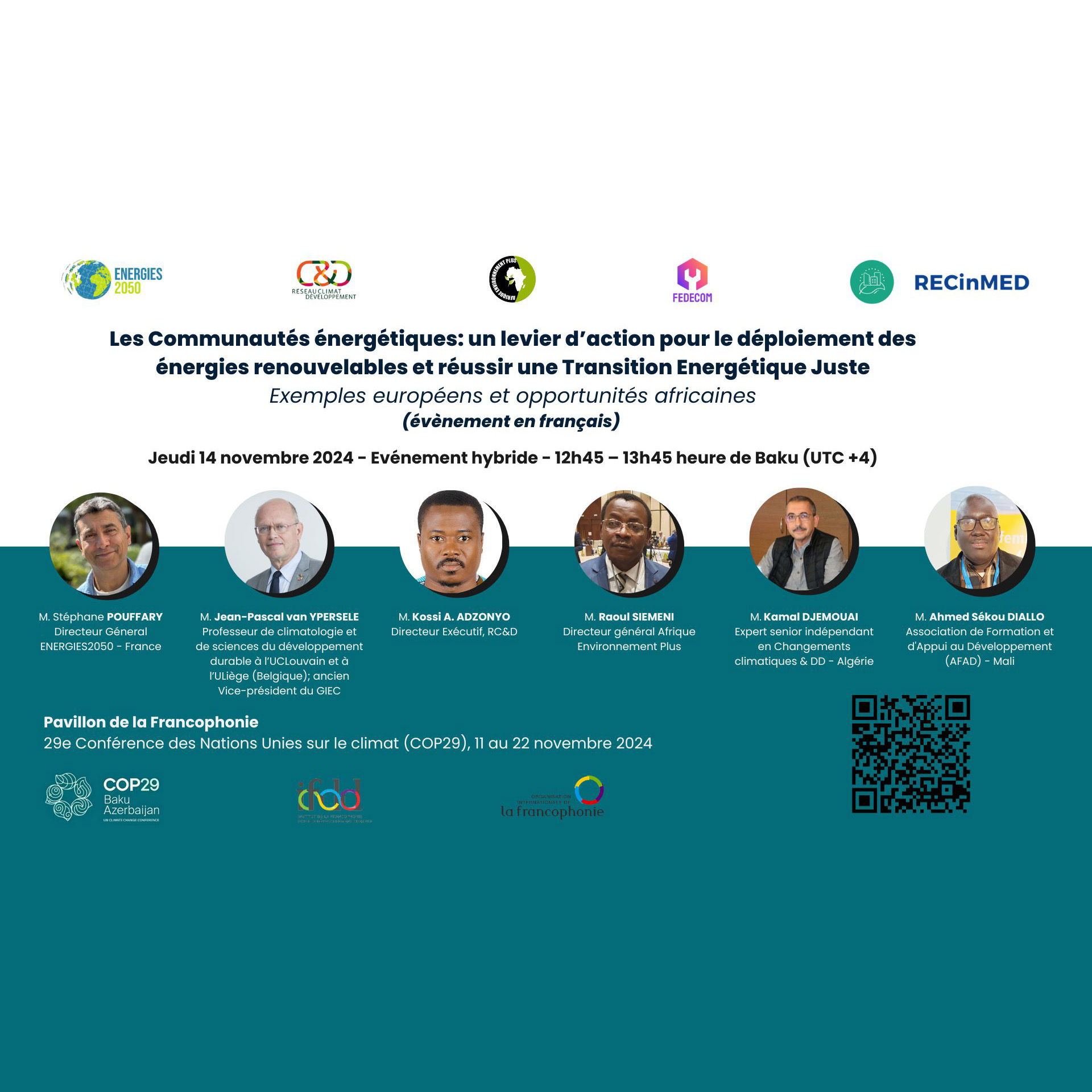
The aim of this event was to foster exchanges on energy communities and decentralized, citizen generated renewable energy production. This approach, already widely deployed in many countries, requires an appropriate regulatory framework, transformations across the entire energy sector, as well as the mobilisation of active consumers placed at the heart of the system.
Among the speakers were:
- Stéphane Pouffary, Chief Executive Officer of ENERGIES 2050
- Jean Pascal van Ypersele, Professor of Climatology and Sustainable Development Sciences at UCLouvain and ULiège (Belgium), former IPCC Vice Chair
- Kossi A. Adzonyo, Executive Director of the Climate and Development Network (RC&D)
- Raoul Siemeni, Managing Director of Afrique Environnement Plus
- Kamal Djemouai, Senior Expert in Climate Change and Sustainable Development
- Ahmed Sékou Diallo, Training and Development Support Association (AFAD)
This event explored the emergence of energy communities as key actors in the transition towards renewable energy and the development of a just energy transition. It presented a panorama of European experiences in decentralized energy production, directly generated by citizens, and examined the conditions under which this model could be adapted to the African context in order to address the region’s specific energy challenges.
In Europe, energy communities are now at the core of energy strategies, with the ambition of making citizens fully fledged energy producers. By 2050, up to 45 percent of renewable energy production in the European Union could come from citizens. This requires not only regulatory developments and technical innovation, but also the engagement of a new category of actors: prosumers, both energy consumers and producers.
This model offers inspiring perspectives for other regions of the world, notably developing countries, where the implementation of such initiatives could play a decisive role in supporting a just and inclusive energy transition.
The event thus shed light on the dynamics at play and the lessons learned from European experiences, and opened the discussion on the opportunities and challenges of adapting this model in countries with regulatory frameworks still under development.


