



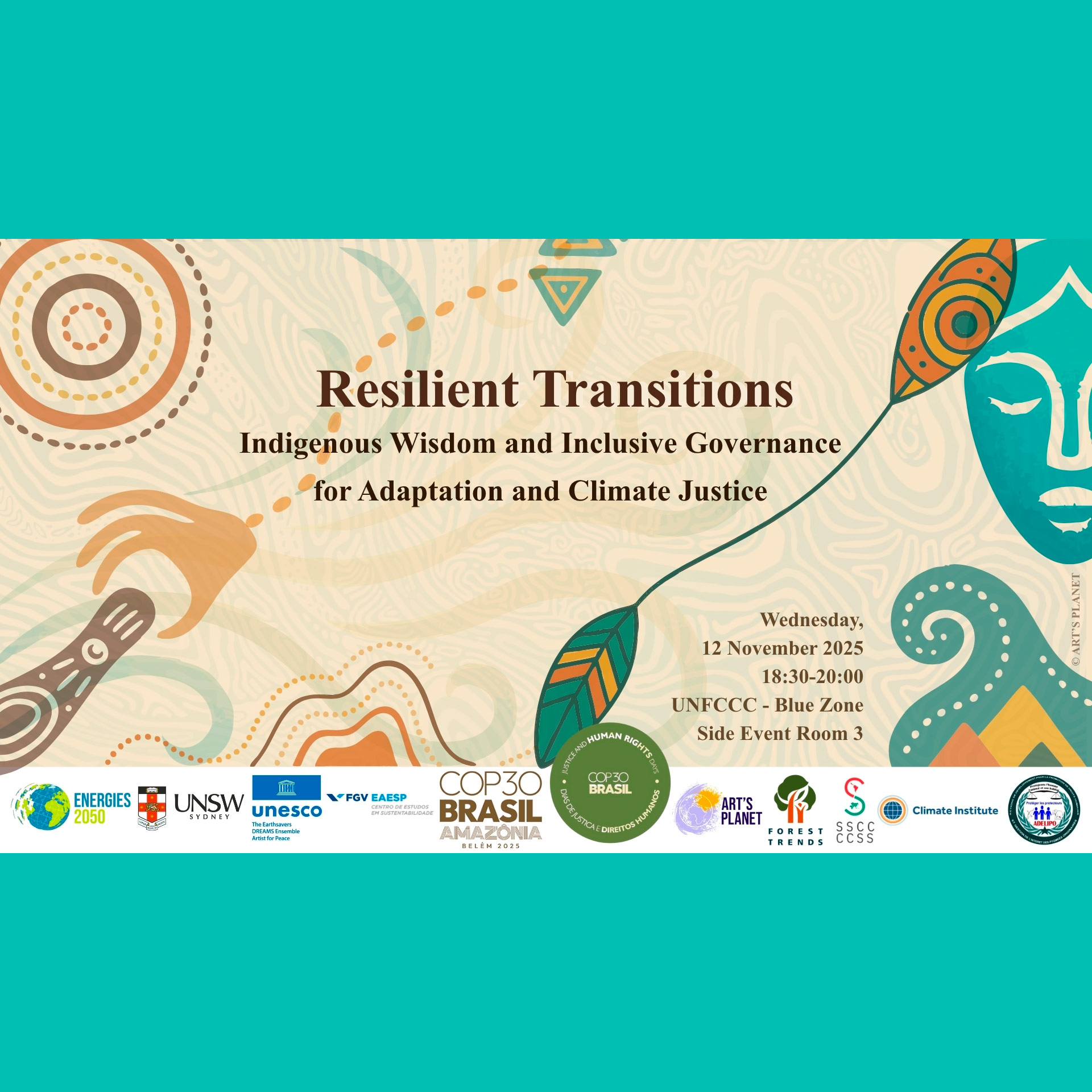
On 12 November 2025, in the framework of COP30, the official UNFCCC side event “Resilient Transitions: Indigenous Wisdom and Inclusive Governance for Adaptation and Climate Justice” took place in the Blue Zone (Side Event Room 3).
Organised at the initiative of ENERGIES 2050 and ART’S PLANET, in partnership with the University of New South Wales (UNSW) – Australia, Earth Savers Movement – Philippines (UNESCO – The Earthsavers DREAMS Ensemble, Artists for Peace) and FGV-GVCes Brazil (Centre of Sustainability Studies), the event provided a high-level dialogue space dedicated to the links between climate change adaptation, climate justice, human rights and indigenous knowledge.
Numerous partners also mobilised around the event, including Forest Trends, the South South Cooperation Council (SSCC) – Colombia, ADELIPO-DR Congo and the Climate Institute – United States.
An event embedded in the COP30 Justice and Human Rights Days
The event was selected as an official event of the first edition of the “COP30 Justice and Human Rights Days”, held on 12 and 13 November 2025, at the initiative of the Office of the United Nations High Commissioner for Human Rights and the COP30 Presidency.
This recognition highlights the relevance of the event in relation to an operational approach to climate change grounded in climate justice and human rights, as well as its contribution to collective work intended to inform reflections, recommendations and lessons learned, to be consolidated and further promoted beyond COP30.
Objectives and approach
The event aimed to explore how indigenous knowledge, inclusive governance models and artistic and cultural expressions can contribute to building resilient and sustainable transition pathways, based on equity, the recognition of rights and collective action.
Discussions highlighted in particular the role of indigenous peoples and local communities in climate change adaptation, the contribution of ancestral knowledge to climate governance, and the importance of art, culture and heritage as levers for social transformation and climate justice, in connection with loss and damage and long-term resilience.
This approach lies at the heart of the actions carried out by ENERGIES 2050, and is embedded in a systemic reading of transitions, bringing together environmental, social, cultural and political dimensions.
The event programme combined a ritual and intercultural opening, based on a ceremony recognising territories and the ethical responsibilities associated with climate-related speech; two thematic panel discussions focusing on ancestral knowledge, climate governance and the links between art, heritage and justice; as well as an artistic sequence illustrating the role of storytelling and creative expression in shaping resilient futures.
Discussions concluded with a collective call to action in favour of more inclusive, just and territorially grounded transition pathways, informed by contributions from speakers from the Global South and Global North, representing indigenous peoples, public institutions, civil society organisations, universities and international networks.
A space for dialogue on resilient and just transitions
By bringing together indigenous leadership, social innovation, inclusive governance and artistic creation, the event contributed to enriching COP30 debates on adaptation, climate justice and human rights.
It reaffirmed the need to fully recognise the knowledge, cultures and rights of indigenous peoples as essential pillars of climate adaptation and resilience strategies, and to promote forms of governance capable of articulating justice, sustainability and long-term transformation.
For more information about the event, the detailed programme is available in the attached document.


