

SUNNY
SUstaiNable eNergy sYstems for refugee and host communities in Africa
Powering Resilience, Empowering Communities: Concrete solutions to build more resilient and inclusive communities.
-
With the support of
European Union’s Horizon Europe programme (Grant Agreement No. 101147546)
-
Geographical area
Africa with two large pilots in Rwanda and Uganda
-
Start date
1 June, 2024
-
Status
Actif
-
Type of activity
Project - Research, Demonstration & replication
-
Duration
48 month (June 2024 – May 2028)
Clean Energy for Refugees and the Water-Energy-Food Nexus
SUNNY tackles energy poverty in refugee and host communities by deploying renewable technologies linked to the WEF nexus, delivering resilient, affordable, and sustainable solutions while reinforcing EU-Africa cooperation for long-term replication.
For Sustainable and Inclusive Access
SUNNY responds to one of Africa’s most pressing humanitarian and development challenges: the lack of sustainable energy access for refugees and host communities. Over 95% of displaced people depend on expensive and polluting fuels, threatening health, food security, and ecosystems. SUNNY delivers renewable energy solutions that are not only technological but systemic, combining innovation with local socio-economic integration. From modular solar home systems and hydrogen cooking stoves to biogas digesters, cold storage and smart irrigation, each technology is adapted to local realities. The project emphasises the Water-Energy-Food nexus, recognising that food security, energy, and resource management are interlinked. Through co-creation, local value chains, circular economy practices and capacity building, SUNNY ensures that these solutions are viable, replicable, and resilient. By bridging humanitarian relief and long-term development, SUNNY contributes to both immediate needs and structural transformation.
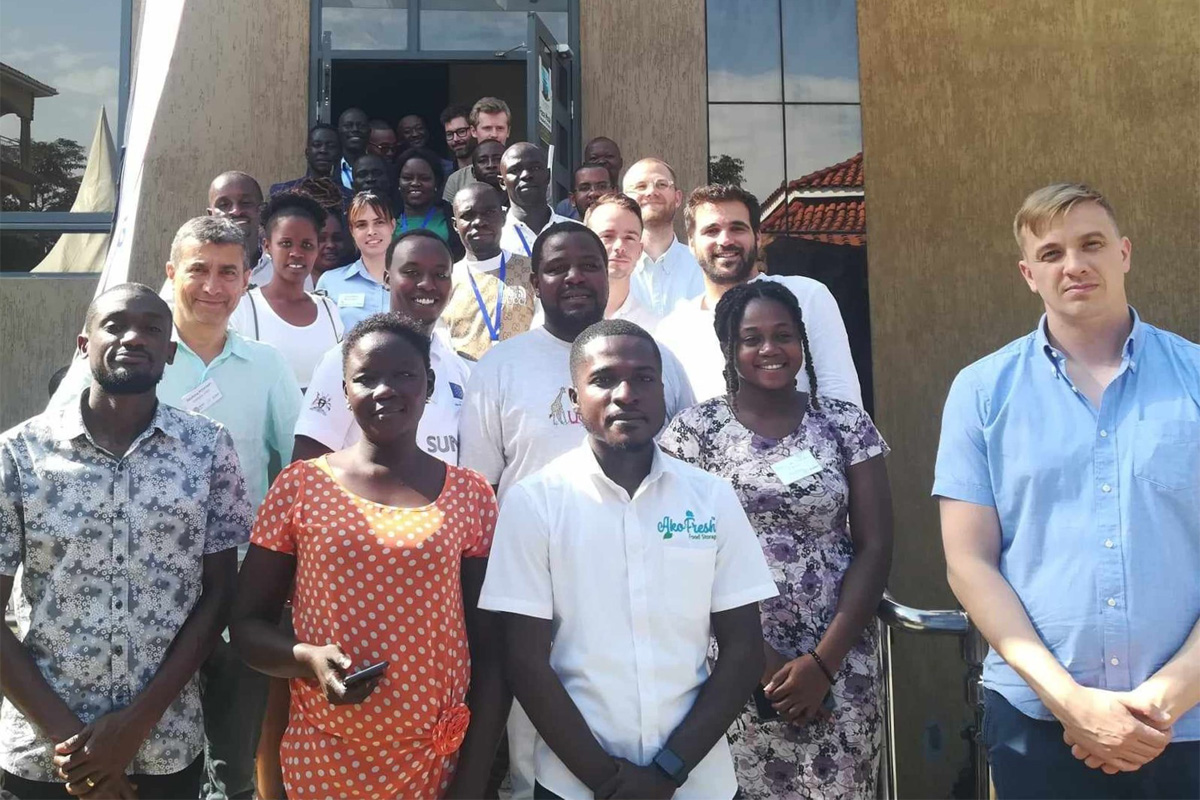
With demonstration sites in Rwanda and Uganda, SUNNY directly impacts more than 1,300 refugees and local residents. Beyond access to clean energy, the project enhances food security, supports women’s empowerment, and creates socio-economic opportunities. SUNNY also serves as a testing ground for innovative financing and business models, ensuring that the solutions demonstrated can be replicated across Africa.
ENERGIES 2050’S INVOLVEMENT
ENERGIES 2050 plays a strategic role in SUNNY by leading regulatory analysis, impact assessments, and the design of inclusive business models. The association ensures that economic and cultural dimensions are fully integrated into the project, making solutions truly relevant to local contexts. Among others, ENERGIES 2050 is in charge of Task 7.2, mapping financial instruments and aid programmes that can support replication and scale-up, while also leading dialogue between the European Union and Africa on energy transition. The organisation coordinates stakeholder engagement and organises replication activities in multiple countries, ensuring that lessons learned in Uganda and Rwanda can inspire wider transformation. By bridging policy, market, and community levels, ENERGIES 2050 strengthens the project’s long-term sustainability and supports EU–Africa cooperation as a driver for systemic change.
SOLUTIONS TESTED ON THE GROUND
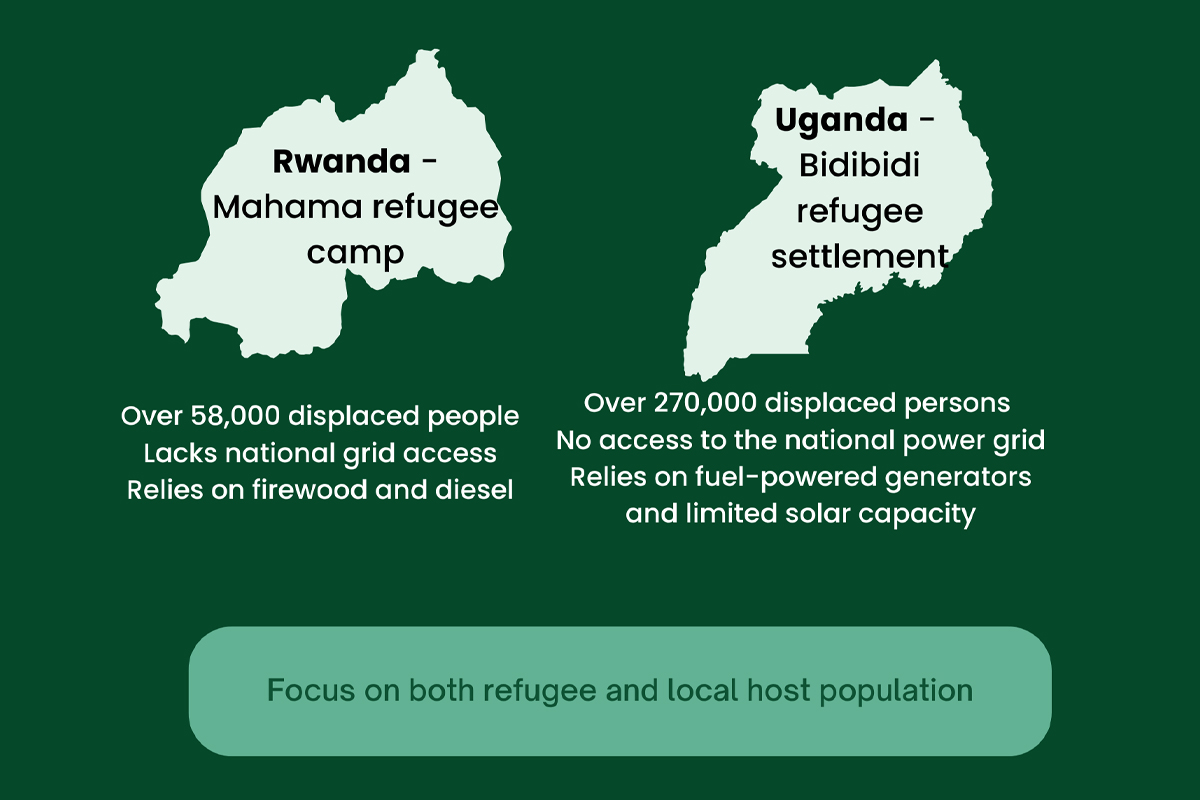
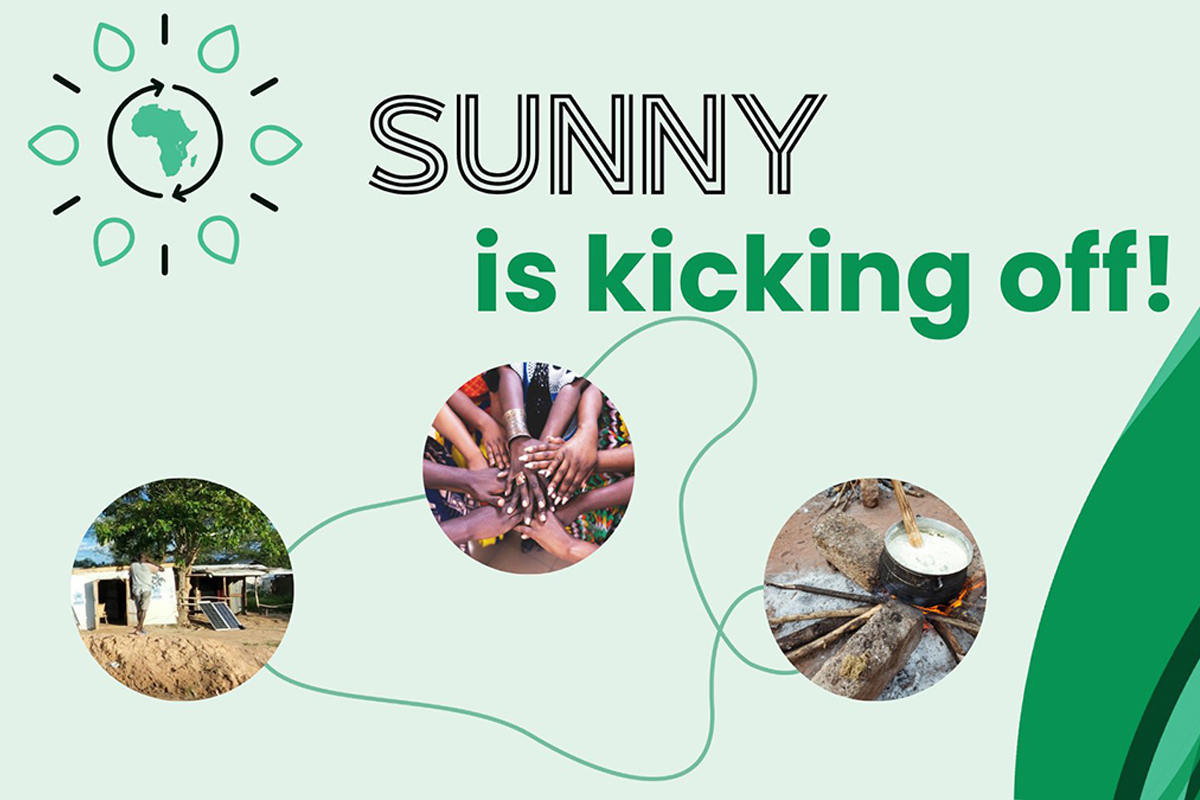
SUNNY pilots renewable energy solutions in two of Africa’s largest refugee settlements: Mahama camp in Rwanda, home to more than 58,000 displaced people, and Bidibidi settlement in Uganda, hosting around 270,000 refugees. At Mahama, families will benefit from enhanced solar home systems with modular storage and hydrogen-based clean cooking, replacing firewood and diesel. At Bidibidi, farmers and households will gain access to biogas digesters, solar-powered cold storage, and smart irrigation systems, enabling safer cooking, reduced emissions, better food preservation and higher agricultural yields. Together, these pilots address the Water–Energy–Food nexus by linking clean energy with food security and resource efficiency. They also promote social cohesion between refugees and host communities by ensuring shared access to solutions. The pilots serve as real-world laboratories to test technologies, business models, and participatory approaches, creating a blueprint for scaling up across Africa.
Expected results
-
Provide safe, reliable, and affordable renewable energy solutions including hydrogen for households and community services.
-
Strengthen local capacities through training, knowledge sharing, and co-creation workshops.
-
Reduce dependency on firewood and fossil fuels, lowering emissions and deforestation.
-
Enhance food security through solar irrigation, biogas, and cold storage solutions.
-
Create inclusive business models that support circular economy and local entrepreneurship.
-
Generate employment opportunities and empower women and youth in host and refugee communities.
-
Provide evidence-based policy recommendations to strengthen EU-Africa dialogue and integration of renewable energy in humanitarian contexts.
-
Develop replicable pathways for scaling solutions to other regions in Africa.
Resources & Downloads
-
Project leaflet
Partners
-
Technische Universität Berlin
GermanyUniversity
-
Lappeenranta-Lahti University of Technology
FinlandUniversity
-
Practical action
United KingdomInternational solidarity NGO
-
Solektra
RwandaRenewable Energy Social Enterprise
-
AkoFresh
GhanaSolar-powered agri-food social enterprise
-
METANOGENIA
SpainBiotechnology company specialised in sustainable energy production
-
SOLHYD
BelgiumImpact startup specialised in renewable hydrogen
-
SOLHYDAIR
BelgiumPrivate foundation dedicated to energy innovation
-
Great Lakes Energy
RwandaCompany specialised in designing and installing solar solutions
-
Terra Energy
RwandaConsultancy firm specialised in renewable energies and e-mobility in Africa
-
Hudara
GermanyNGO for solidarity and sustainable development
-
ENERGIES 2050
FranceInternational NGO dedicated to climate and sustainable development
-
ReFuse
LebanonSocial enterprise promoting zero waste through recycling and environmental solutions
-

Makerere University
UgandaUniversity
-

University of Rwanda
RwandaUniversity
-
Community Technology Empowerment Network (CTEN)
FranceRefugee-led digital skills NGO
-
Euroquality
FranceSME specialised in innovation consulting
support us
ENERGIES 2050, independent and without operating subsidies, relies on the generosity of donors like you to sustain and expand its actions. Support our work with a donation or explore other ways to contribute.